
In this article
- Define the objective and audience
- Choose the format before the venue
- Assess the Kolkata venue against the agenda
- Build a complete event budget
- Create an agenda and a working run sheet
- Plan corporate catering around the programme
- Make guest communication clear
- Final checks before the event
- Corporate event planning questions
Corporate event planning starts with a business purpose and a clear guest experience. Decide what the event needs to achieve, who is attending and what they should be able to do during the programme. Then build the venue, agenda, catering and technical arrangements around that brief.
For a Kolkata conference, team gathering, client event or product launch, keep the decisions in one working plan. The agenda, room layout and food service affect one another, so they should be coordinated before suppliers finalise their individual arrangements.
Define the objective and audience
Write a short statement of purpose. A training day needs participants to hear, see and work comfortably. A client gathering may prioritise conversation and hospitality. A launch needs a clear reveal or presentation sequence. Each requires a different room and service plan.
Identify the audience, expected attendance and any guests who need particular arrangements. Decide what success will look like: useful participation, completed sessions, introductions or another result relevant to the organiser.
Choose one internal decision-maker and a working contact who can coordinate suppliers. This avoids conflicting instructions from separate departments as the event approaches.
Choose the format before the venue
| Event format | Planning emphasis | Food-service question |
|---|---|---|
| Conference or seminar | Clear presentation, seating and a workable agenda | How do refreshment and lunch breaks fit the sessions? |
| Training workshop | Participation, materials and group-work space | Can food service support the breaks without disturbing the room? |
| Client gathering | Arrival, conversation and hosted introductions | Will circulated refreshments or seated dining suit the interaction? |
| Product launch | Presentation sequence, demonstration and guest movement | When should counters open relative to the main programme? |
| Team celebration | Shared activities, recognition and comfortable hosting | How will the meal fit with speeches or entertainment? |
Assess the Kolkata venue against the agenda
Ask for a layout showing the actual seating, stage, screens, registration and food areas. A room’s maximum capacity is less useful than the number it can accommodate in your working arrangement.
Review guest access, washrooms, supplier loading, power and the spaces available for breaks. If connectivity is important to the programme, arrange the necessary checks with the venue and technical supplier rather than relying only on a general Wi-Fi description.
Confirm catering and equipment policies before appointing external teams. Share the exact Kolkata location and access requirements with everyone responsible for delivery.
Build a complete event budget
Group the costs into venue, food and service, technical production, furniture or branding, programme support and guest arrangements. Record what is included in each proposal so that an item supplied by the venue is not also ordered elsewhere.
Track the planned amount, quoted amount, approved commitment, payments and balance. Reserve a contingency allowance with a defined approval process. Confirm the organisation’s requirements for invoices, purchase approvals and payment dates before bookings are made.
When comparing proposals, use the same guest count, working hours and scope. A food-only rate cannot be compared directly with a broader event package.
Create an agenda and a working run sheet
The guest agenda should be easy to read. The run sheet needs the operational detail: supplier access, registration opening, presentation handovers, refreshment breaks, meal service, guest departure and clearance.
Give each transition an owner. Someone should know who cues the speaker, tells the caterer a session is finishing and authorises a timing change. Include time for people to move between rooms rather than scheduling every session back to back.
For a launch or presentation-heavy event, agree a rehearsal or technical walkthrough suited to the programme. Confirm the final files, display arrangements and the person authorised to approve changes.
Plan corporate catering around the programme
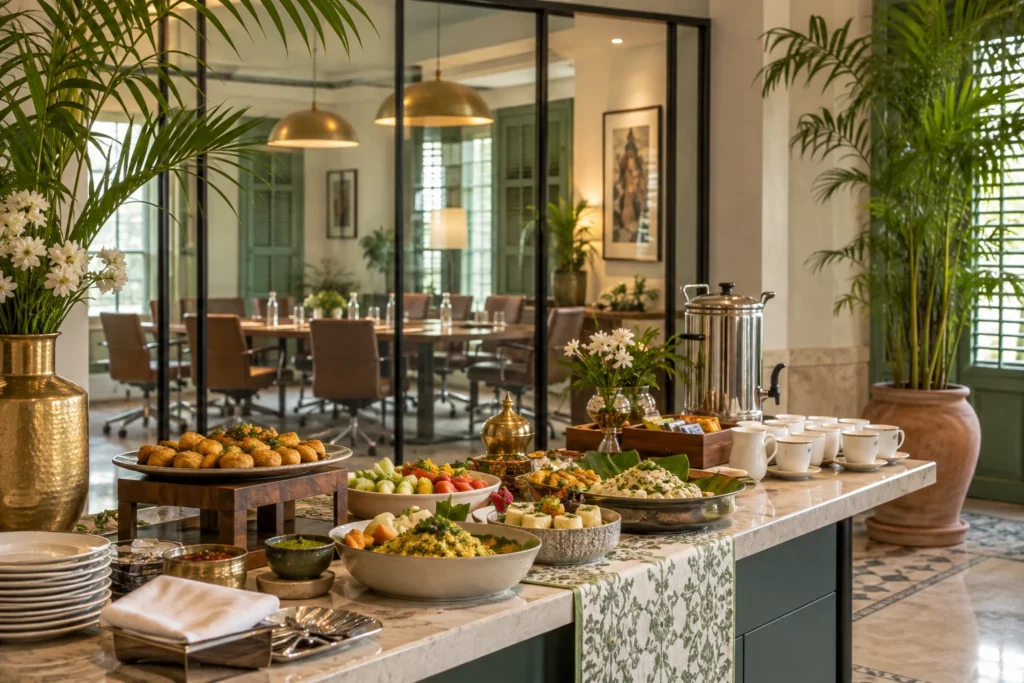
Choose the food to support the way guests will work and interact. Registration refreshments, a short tea break and a full lunch are different service moments. Give each a place and a defined window.
A networking event may suit refreshments that can be served without interrupting conversation. A workshop lunch needs enough time for participants to eat and return. The menu should match the room and the practicalities of service.
- Confirm expected diners separately from the total registration list.
- Collect specific food requirements through the organiser’s appropriate process.
- Provide a complete vegetarian meal and clear dish identification.
- Keep food queues away from registration and session entrances.
- Agree water, crockery, staff, replenishment and clearance.
- Identify who tells the team if the agenda runs early or late.
Explore corporate catering in Kolkata to discuss the food and service brief alongside the programme.
Make guest communication clear
Provide the event purpose, location, arrival time and any practical attendance instructions. Give guests a straightforward way to raise access or food requirements with the organiser.
At the venue, use clear registration and directional signs. Keep the event name, room names and agenda wording consistent across invitations, displays and staff instructions.
If attendee information is shared with suppliers, provide only what they need for their agreed role through the organisation’s approved process. Food counts and operational requirements can often be communicated without circulating a complete guest database.
Final checks before the event
- Approve the current agenda, run sheet and guest-count basis.
- Confirm venue access, layouts and supplier working times.
- Check the technical arrangements against the actual presentation plan.
- Confirm menu, ingredient requirements and service windows.
- Give every supplier a named operational contact.
- Review approvals, invoices and outstanding payments.
- Define who records issues and gathers feedback afterwards.
Corporate event planning questions
What should a corporate event brief include?
Include the objective, audience, expected attendance, format, date, location, agenda, budget and services required. Identify the organiser’s decision-maker and operational contact.
When should catering be planned?
Plan it alongside the agenda and venue layout. Refreshments, lunch and dinner each need appropriate space, time and communication with the programme team.
What is the difference between an agenda and a run sheet?
The agenda tells guests what is happening. The run sheet gives the delivery team the timings, responsibilities and handovers needed to make the programme work.
Discuss your event with GS Signature’s corporate event planning team in Kolkata. Use the form to request a callback about your programme, venue and catering needs.
Bring your occasion into focus
Let’s plan the details
around your guests.
Share your name, email and phone. We’ll discuss the occasion, venue and menu with you.
Discuss your plans