
In this article
- Identify what you want to preserve
- Old-school and modern menu directions compared
- A Bengali dinner menu with a familiar progression
- A modern reception with a Bengali centre
- How to make a hybrid menu work
- Service changes the experience as much as the food
- Should the wedding and reception have different menus?
- Bengali wedding dinner and reception questions
An old-school Bengali wedding menu usually means the food a family remembers from its own biye bari meals: a clear progression, familiar preparations and a sweet finish worth waiting for. A modern reception might add moving starters, a buffet, live counters or dishes from other cuisines. The useful decision is which of these approaches will suit your guests and the way you want to host.
There is no single historical menu that represents every Bengali household. Here, “old-school” describes a family-led, course-based direction rather than a fixed menu from a particular decade. Start with the dishes that matter to your family, then decide where a different service style would genuinely improve the evening.
Identify what you want to preserve
Ask the family for three food memories, not an unlimited wish list. It might be luchi with cholar dal, the anticipation of the fish course, a favourite mutton preparation or mishti doi served after chutney. Those choices give the menu a centre.
Then ask what made the meal enjoyable. Was it seated service, the order of the dishes, a recipe associated with the household, or time spent eating together? You can preserve that quality even if the venue and guest count are very different from the wedding everyone remembers.
Use our Bengali wedding menu course-order guide to connect those memories with a complete meal.
Old-school and modern menu directions compared
| Decision | Family-led course meal | Modern reception spread |
|---|---|---|
| How guests eat | A chosen sequence, often suited to seated service | More freedom to choose counters and timing |
| Menu emphasis | Selected Bengali preparations and their accompaniments | A Bengali core with selected additional cuisines or live stations |
| Host’s main task | Coordinate the serving rhythm and seating | Coordinate circulation, queues and replenishment |
| Where it can become difficult | Too many courses for the available meal window | Too many counters for the usable venue space |
| Useful finishing choice | A focused traditional sweet course | Selected sweets with any other dessert planned alongside them |
These are planning directions. Seated service can feel contemporary, and a buffet can serve an entirely Bengali menu. The food and the method of serving it are two related decisions that you can make separately.
A Bengali dinner menu with a familiar progression
For a family-focused dinner, begin by choosing the rice or breads and the principal fish or meat dishes. Build the vegetables, dal and vegetarian main around them. Finish with chutney, papad and a small selection of sweets.
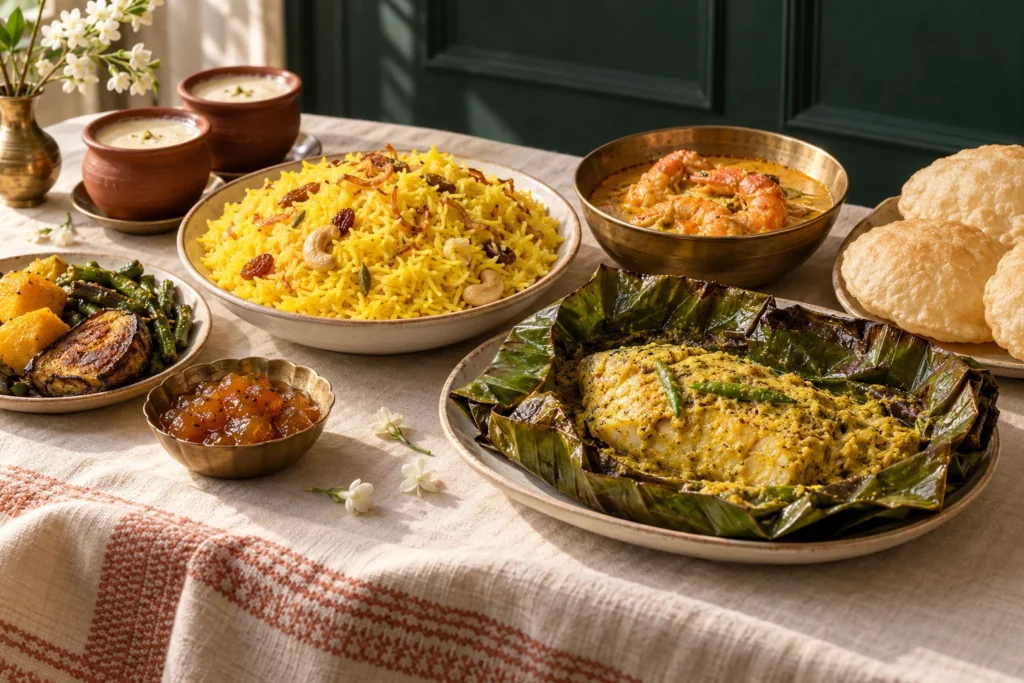
One possible direction is luchi with cholar dal, basanti pulao with a vegetable or chhana preparation, a chosen fish course and the family’s preferred main, followed by chutney and sweets. Another household might prefer a rice-led sequence with dal, bhaja and more vegetables. Confirm the exact dishes instead of treating either list as a required tradition.
Keep welcome refreshments separate from the main meal brief. A full starter spread can change how much of the dinner guests want to eat, especially if several functions have already filled the day.
A modern reception with a Bengali centre
Choose one or two additions that have a clear role. A live snack counter can give early arrivals something to enjoy. A different vegetarian preparation can make the spread more inclusive. A seasonal drink can refresh the welcome without adding another full food course.
A modern Bengali reception menu might combine welcome drinks, contrasting starters, a focused Bengali main buffet and selected sweets. If you add a live counter, decide whether it belongs to the welcome period or dinner. That prevents a popular station from competing with the main meal at exactly the wrong moment.
Do not judge variety by the number of cuisines alone. Several dishes with the same rich texture can feel less varied than a shorter menu with a clear balance of lighter and fuller preparations.
How to make a hybrid menu work
- Keep a clear main meal. Guests should understand what makes up dinner, even when several counters are open.
- Choose one memorable addition. Give it adequate space, staff and a defined serving window.
- Plan a complete vegetarian route. Include starters, accompaniments, a substantial main and dessert choices that match the agreed ingredient brief.
- Use consistent naming. The menu card, buffet labels and caterer’s dish list should describe the same preparations.
- Give the sweets their moment. Coordinate cake, ice cream or other desserts with the Bengali sweet course rather than ordering each separately.
Explore our Bengali menus to shortlist the core dishes, then discuss the additions through the menu builder.
Service changes the experience as much as the food
A course-based meal needs a seating and serving plan that fits the number of guests. Discuss how tables will be filled, how dishes will follow one another and how guests arriving later will be accommodated. Ask the caterer how the meal will remain coherent across more than one sitting.
A buffet needs a route. Where will plates be collected? Can someone reach the vegetarian dishes without crossing a queue? Is dessert positioned so it does not block the main counters? A long menu cannot compensate for a layout that makes eating difficult.
For a Kolkata home or a venue with an older entrance and staircase, share access details before the equipment and staffing plan is agreed. Our catering area directory can help you begin the neighbourhood-specific conversation.
Should the wedding and reception have different menus?
They can share a family favourite while offering different meals. Consider the time of day, the guests attending both functions and what is being served elsewhere in the programme. A daytime meal and an evening reception do not have to repeat the same starters, mains and sweets.
Use one planning sheet for the full celebration. List each function, expected guests, food direction, service window and the dishes you especially want to avoid repeating. This makes the decisions easier to see before individual menus become final.
Bengali wedding dinner and reception questions
What belongs on an old Bengali wedding menu?
Begin with the dishes and serving sequence your household associates with a wedding meal. Rice or breads, dal, vegetables, fish or other chosen mains, chutney and sweets can form the discussion. The exact list varies by family and occasion.
Can a modern reception still have a fully Bengali menu?
Yes. Modern styling or buffet service does not require several cuisines. You can serve a focused Bengali menu with clear labels, a complete vegetarian selection and a carefully planned dining layout.
How many live counters should we add?
Choose around the available space, serving window and main meal. Start with the counter that adds the most to your guest experience, then confirm whether the venue and service plan can comfortably support it.
Discuss a traditional, modern or blended meal with GS Signature’s wedding catering team in Kolkata. Use the form to share your contact details, and bring the family’s must-have dishes to the conversation.
Bring your occasion into focus
Let’s plan the details
around your guests.
Share your name, email and phone. We’ll discuss the occasion, venue and menu with you.
Discuss your plans